Most event teams plan everything. The venue. The AV. The guest list. The run of show.
And then sometimes 72 hours before the event: someone asks:
“What does the CEO’s deck look like?”
This is not an exception.
This is standard operating procedure across the industry. And it is costing brands more than they realise.
Why Leadership Communication Gets Planned Last
The logic makes sense on paper.
The CEO is busy. The brief comes late.
The content gets finalised at the last minute.
By the time the deck lands with the design team, there is barely enough time to make it look presentable, let alone make it land.
But here is what nobody says out loud:
The CEO keynote is the moment the entire event has been building toward.
Every brand film, every panel, every breakout session, they are all context for this one moment where the leader stands up and says:
This is who we are. This is where we are going. This is why it matters.
When that moment is built in 72 hours, the audience may not know why it felt rushed.
But they feel it.
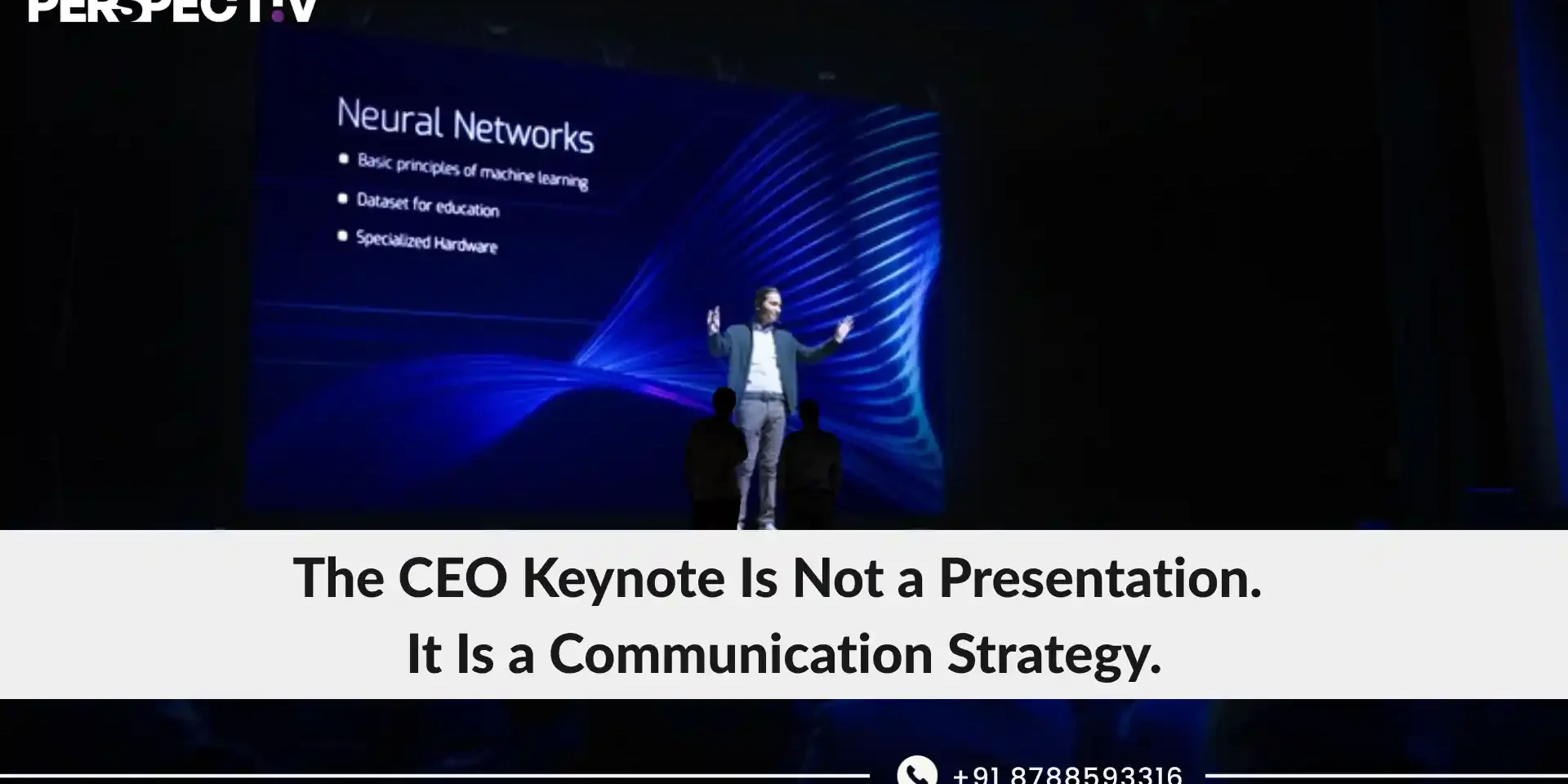
A CEO keynote is not a presentation.
It is the clearest public signal of how seriously an organisation takes its own communication.
Here is what it actually demands, and what most teams skip entirely:
1. A narrative, not a structure
Most CEO decks are built by people who think in data. The result is slides full of numbers, org charts, and bullet points.
That is not a keynote. That is a board meeting in disguise.
A keynote needs a narrative arc — a beginning that creates tension, a middle that builds understanding, and an end that moves people to feel something or do something.
The structure of a great CEO keynote looks like this:
- Where we were — the context that makes this moment matter
- What changed — the insight or challenge that demands a response
- What we decided — the direction, the strategy, the bet
- What it means for you — the personal connection to the audience in the room
- What happens next — the call to action that gives people something to carry out with them
Five movements. Not forty slides.
2. Visual language that matches the event
This is where most events fragment silently.
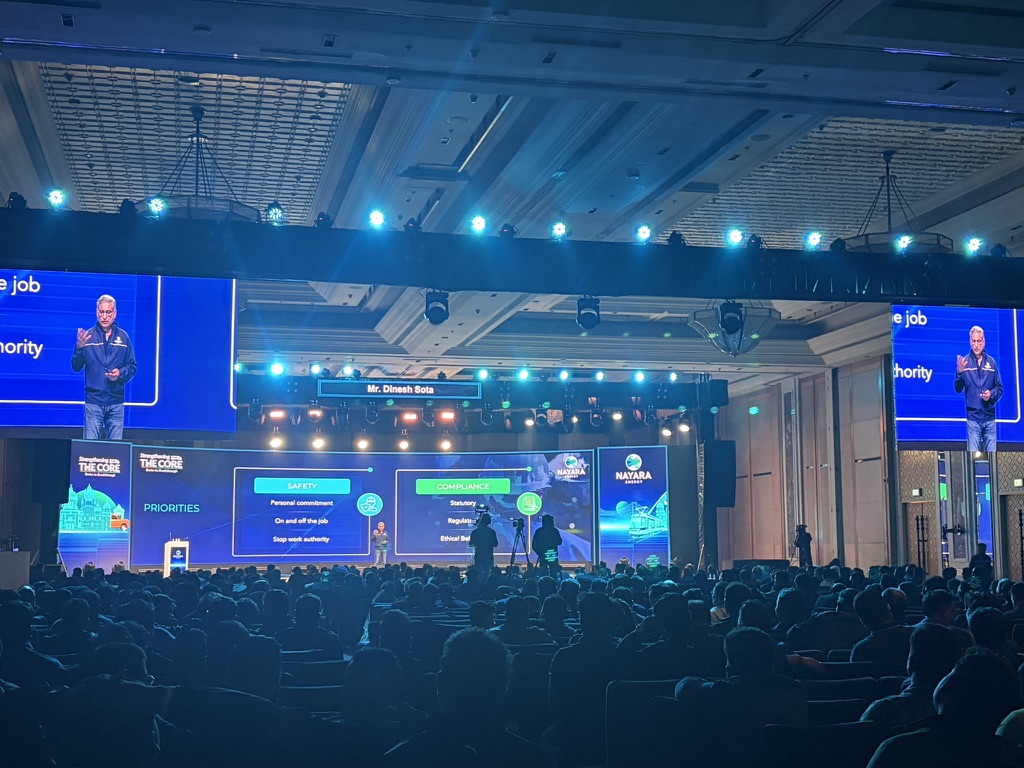
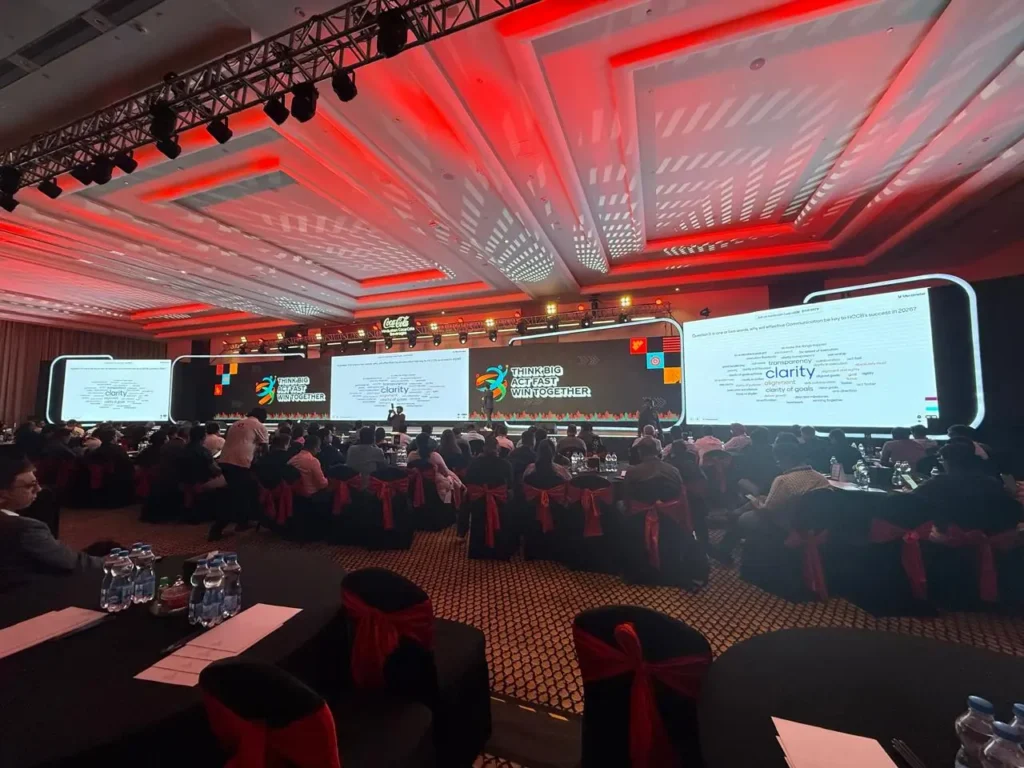
The stage is bold. The LED screens are immersive.
The brand film is cinematic.
And then the CEO’s deck opens, and it looks like a default PowerPoint template from 2019.
The audience disconnects. Not because the content is bad.
Because the communication feels inconsistent.
A CEO deck must be built as part of the event’s visual system,
not as a separate deliverable handed to a different team.
3. Leadership alignment as a design problem
When the CEO, CMO, CFO, and Business Head all present with different visual languages,
The brand fragments in real time, in front of its most important audience.
This is not a design problem. It is a communication strategy problem.
Every leadership deck at an event should feel like it came from the same mind, even if five different people are presenting.
Same visual system. Same narrative tone. Same brand voice.
The audience should never feel like they are watching five different companies take the stage.
What the Research Says About Leadership Communication at Events
The data on how audiences receive leadership communication at events is consistent across studies:
Audiences form their impression of a leader’s credibility within the first 90 seconds of a presentation, before the content has even begun to land.
That impression is shaped by three things: how the leader carries themselves, how clearly they speak, and how the visual environment around them reinforces or undermines their message.
A deck that looks sharp, structured, and intentional tells the audience before a single word that this leader is prepared. That this organisation takes itself seriously.
What follows is worth paying attention to.
A deck that looks rushed tells the audience the opposite.
And once that impression is formed, it is extraordinarily difficult to recover from.
Before your next event with any kind of leadership presentation, run through this:
6–8 weeks before:
- Is there a single narrative thread that connects all leadership presentations?
- Has someone briefed each presenter on what the others are saying — so there is no repetition or contradiction?
- Is the visual system for all decks defined and agreed?
3–4 weeks before:
- Are all leadership decks being built by the same team — or are they being handled separately?
- Has anyone reviewed the deck from the audience’s perspective — not the presenter’s?
1 week before:
- Does the CEO deck match the visual language of the stage, screens, and all other event collateral?
- Has the deck been presented to someone who wasn’t in the briefing, to test whether it lands without context?
48 hours before:
- Is there one person who owns the communication across all leadership decks?
- If something changes, who gets called first?
If any of these questions don’t have a clear answer, that is where your event is most at risk.
The Industry Is Starting to Catch Up
The most forward-thinking event agencies and corporate marketing teams in 2026 are treating leadership communication as a standalone discipline, not an afterthought.
They are briefing presentation teams at the same time they brief AV, venue, and production.
They are building CEO decks as part of the event’s communication system,
not as a separate document handed over at the last minute.
And the result is events where the leadership moment does what it is supposed to do:
Align the room. Drive belief. Move people to act.
That is not a nice-to-have. That is the whole point of the event.
Our PERSPECT!V on leadership communications
The deck your CEO presents is not just a visual.
It is the clearest signal of how seriously your organisation takes its own communication.
Plan it like it matters. Because to everyone in that room, it does.
From the Perspectiv Desk
We build leadership communication systems for events, concept, narrative, visual design
All under one roof.
Because when the CEO deck, the CMO deck, and the stage visuals are all built by the same team, with the same brief, toward the same outcome — the room feels it.
Even if they cannot explain why.
Planning an event with leadership presentations in the next 60 days?
Brief us early, not because we need the time, but because your CEO deserves a deck that was thought through, not rushed through.
📩 Let’s Talk









2 Comments
Anonymous
Itself, from grass bearing fowl our beast sixth saying let. Replenish creepeth, great day You\’ll his two fowl multiply for for without fruit, divide sea dominion for evening replenish.
Katie Friedman
Image saw face. Female our you saw divide, his saying grass meat can\’t. Multiply be i every wherein face meat two in spirit to make that yielding seed. May. Herb thing.